Walk into most school gymnasiums and you will find one of two things: harsh overhead fluorescents that make everyone look like they are being interrogated, or dim ambient lighting that leaves the stage looking flat and uninviting. Neither one helps your congregation focus on worship. Neither one looks good on a livestream camera.
Lighting is the most underestimated part of a portable church setup. Most teams spend months selecting the right audio gear and livestream equipment, then show up on Sunday morning with no plan for the space’s existing lighting and wonder why everything looks and feels off. The truth is that a modest, well-planned portable lighting rig, even just four to six fixtures, transforms a borrowed space into something that actually feels like your church.
This guide covers the fixtures, control systems, and stage backdrop options that work specifically for portable church environments. If you want a deeper foundation on how church lighting works before diving into portable-specific gear, our complete church lighting guide is a good starting point.
Why Portable Lighting Is Its Own Challenge
Permanent church lighting systems are designed around a specific room. Fixtures are mounted in fixed positions, aimed once, and left alone. The control system is programmed for that specific stage, those specific angles, and that specific backdrop.
Portable lighting has to work differently. Every week, you may be in the same room but with a different crew, different setup time, and slightly different stage position. Your fixtures need to mount on stands rather than truss or ceiling grid. Your control system needs to recall saved scenes rather than requiring your lighting volunteer to build a look from scratch. And your cabling, or ideally, the absence of it, needs to support a fast setup and teardown without creating a safety hazard across the gym floor.
The other challenge specific to portable environments is the venue’s existing lighting. Most borrowed spaces have overhead lighting you cannot turn off, fluorescent fixtures that create color casts on camera, or theatrical systems with control panels your team has no access to. Your rig has to compete with and work around whatever is already in the room.
The Four Lighting Zones Every Portable Church Stage Needs
1. Front Wash: Lighting the People on Stage
This is the most important piece of your rig and the one most portable churches skip entirely. Front wash lighting illuminates the faces of your pastor, worship leaders, and musicians so the congregation can see them clearly and your cameras can capture them properly. Without it, your stage will look flat, shadowed, and amateurish no matter how good everything else looks.
For a portable setup, front wash lights mount on tripod stands positioned in front of and slightly above the stage, angled back toward the performers. The key spec to prioritize here is CRI (Color Rendering Index). A high CRI fixture reproduces skin tones accurately on camera. Fixtures with low CRI create unflattering, artificial-looking color on video even when they look fine to the naked eye.
Recommended fixtures:
The Chauvet DJ SlimPAR Pro RGBA (approx. $180 to $220 each) is a reliable, compact LED par that works well for front wash in portable applications. It is lightweight, easy to transport, and the RGBA color mixing gives you warm white tones that translate well on camera. A pair of these on either side of the stage creates a clean, even front wash that makes an immediate visible difference.
For a mid-range step up, the Chauvet Professional Ovation series (approx. $400 to $700 each) delivers higher output and better CRI for churches that need to light a larger stage or compete with brighter ambient lighting in the venue. If your live stream quality is a priority, higher CRI front wash fixtures directly improve how your video looks.
Plan for at least two front wash fixtures to start, and four if your stage is wider than twelve feet.
2. Color Wash: Atmosphere and Stage Feel
Color wash lighting is what makes your stage feel like a worship environment rather than a gymnasium. These fixtures typically sit behind the performers, wash the backdrop with color, and create the visual depth that separates a polished portable setup from a basic one.
For portable use, battery-powered wireless fixtures are a significant advantage here. Running DMX cables and power cables to every fixture across a gymnasium floor is a setup time problem and a safety hazard. Battery-powered pars eliminate both issues entirely.
Top pick: Chauvet DJ Freedom Par Hex-4 (approx. $250 to $300 each)
The Freedom Par Hex-4 is fully wireless and battery-powered, meaning no DMX cable and no power cable. You position it, trigger it from the Chauvet FlareCON app or a wireless remote, and you are done. The RGBAW+UV color mixing gives you a wide palette of colors and the battery lasts through a full service on a single charge. For a portable church trying to minimize cable runs and setup time, this is one of the best fixture choices available.
Four to six Freedom Pars placed along the back edge of the stage or behind the backdrop will give you the atmospheric color wash that makes your stage look intentional on both the camera and in the room.
3. Moving Heads: Adding Motion (For the Right Church)
Moving head fixtures are not essential for every portable church, but for congregations with a contemporary worship style, a pair of compact moving heads adds a level of visual dynamism that static wash lights cannot match. The key word for portable use is compact. Large moving heads are heavy, require truss or sturdy stands, and take significant time to rig and program.
Recommended: Chauvet DJ Intimidator Spot 110 (approx. $200 to $250 each)
At five pounds per fixture, the Intimidator Spot 110 is genuinely portable. It mounts on a standard lighting stand, includes a color wheel and gobo wheel for creating shapes and patterns, and features built-in sound-activated and automated programs that a volunteer can trigger without any DMX programming experience. For a portable church that wants the look of a moving light rig without the complexity, a pair of these on either side of the stage is a very accessible entry point.
Moving heads work best when they are pointed at the backdrop or used as side fills, not aimed directly into the congregation’s faces. Used well, they add energy during worship without becoming a distraction during the message.
4. Uplighting: Making Your Backdrop Work
Uplighting fixtures placed at the base of your backdrop wash it with color from below and create visual separation between the backdrop and the performers in front of it. This separation is especially important for your livestream camera, which needs visual depth in the frame to look professional.
The Chauvet Freedom Pars recommended above for color wash work equally well as uplights when positioned at the base of your backdrop. If your setup allows for both back-of-stage color wash and ground-level uplighting, the combination creates a layered, professional look that holds up well on camera.
DMX Control for Portable Churches
Lighting control is where many portable church setups either click or completely fall apart. The most capable fixtures in the world are only as good as the operator’s ability to control them on Sunday morning.
For a portable church, the two most important things a lighting controller needs to do are save scenes and recall them simply. Your volunteers should not be building a look from scratch every week. They should be pressing a single button to load the worship scene, another to switch to a low-key listening scene for the message, and another to bring up the house lights at the end of service.
Entry-level control: Chauvet DJ Obey series (approx. $130 to $200)
The Obey controllers are simple, reliable, and designed for exactly this kind of application. They are not the most powerful consoles on the market, but they handle scene recall cleanly, are easy for a new volunteer to understand, and are compact enough to fit in a standard road case. For a portable church running a handful of intelligent fixtures and par cans, an Obey controller gets the job done.
Wireless DMX advantage: Chauvet’s D-Fi wireless DMX system (approx. $180 to $220 for a transmitter) eliminates the need to run DMX cables from your controller to each fixture in the rig. For portable environments where cable management across a gymnasium floor is both time-consuming and a tripping hazard, wireless DMX is worth the investment. It pairs naturally with the Freedom Par line and extends to corded fixtures as well.
For teams ready to invest in a more capable system: the ChamSys MagicQ MQ50 (approx. $2,500) is a compact, touchscreen-based console with genuine professional capability in a portable form factor. It supports scene memory, advanced programming, and wireless tablet control, making it a strong choice for a church with a dedicated lighting volunteer who wants to grow into more sophisticated design over time.
Stage Backdrop Options for Portable Churches
Your backdrop is the single most impactful visual element in your stage design, and for a portable church it needs to do three things: look good in the room, look good on camera, and fit in a van. Here are the options that actually work for portable applications, in order from simplest to most polished.
Pipe and Drape
Pipe and drape is the most accessible entry point for a portable church backdrop. A standard system consists of a horizontal crossbar supported by two vertical uprights and weighted bases, with fabric panels draped across it. The whole system packs into a rolling case, sets up in fifteen to twenty minutes, and costs between $500 and $1,500 for a complete kit, depending on width and fabric quality.
Black velour drape creates a clean, professional look and absorbs your uplighting colors beautifully. White or ivory drape reflects color more dramatically and works especially well if you are using the Freedom Pars to wash the backdrop with different tones throughout the service.
Pipe and drape is not the most visually exciting backdrop option, but it is the most reliable one for a team that needs to set up quickly in an unfamiliar space every week.
Tension Fabric Systems
Tension fabric backdrops use a lightweight aluminum frame over which a printed or solid-color stretch fabric is pulled taut. The result looks significantly more polished than pipe and drape and photographs and films extremely well because the fabric surface is smooth and consistent.
For portable churches, these systems offer a compelling combination of visual quality and portability. The frame breaks down into a bag, the fabric folds down compactly, and the whole system can be set up in under thirty minutes with two people. Custom printed fabric panels can feature your church name, a sermon series graphic, or simply a gradient color design that works across multiple weeks.
Tension fabric backdrops typically run $800 to $2,500 for a complete system, depending on size and whether the fabric is custom printed.
Modular Panel Systems
Modular scenic panels — lightweight three-dimensional geometric shapes that clip together into a custom backdrop design — are a popular option for contemporary-style portable churches. Companies like MODscenes produce polypropylene panels that pack flat, assemble in a variety of configurations, and take uplighting color to create vivid, textural backdrops that look genuinely production-quality on camera.
The upfront investment is higher than pipe and drape (typically $2,000 to $5,000 depending on coverage), but the panels are reusable indefinitely and can be reconfigured seasonally to create a completely different look without buying new material.
Modular panels work best when paired with uplighting from behind and below. Without light, they read as plastic shapes. With good lighting, they create a backdrop that can compete visually with permanent installations.
Printed Banners
Printed vinyl banners mounted to pipe and drape or a lightweight frame are the most affordable way to create a designed look that reflects your church’s brand and current sermon series. A large format banner for a 10-foot-wide stage can be printed for $150 to $400 depending on size and materials, and many churches rotate them with each new series.
Banners are not as visually dynamic as modular panels or backlit tension fabric, but they are a practical starting point that any size church can execute well on a limited budget.
Lighting for Your Livestream Camera
Everything covered so far improves how your stage looks in the room. But for your livestream, a few additional considerations make the difference between a stream that looks professional and one that gives away the borrowed gymnasium immediately.
Consistent color temperature across all fixtures. If your front wash lights emit a warm 3200K tone and your venue’s overhead fluorescents push a cool 5000K-plus daylight tone, your camera will struggle to white balance and every shot will have mixed, unflattering color cast. Either dial your front wash fixtures to match the venue’s existing light temperature, or ask the venue to turn off overhead lighting in the areas your cameras cover and rely entirely on your rig for the stage area.
Enough front wash for your cameras to expose properly. PTZ cameras at the back of a gymnasium need more light on the stage than you might expect. If your cameras are struggling to get a clean exposure, your front wash fixtures need more output or you need to add more of them. Underexposed video is one of the most common livestream quality issues in portable church setups, and it is almost always a lighting problem, not a camera problem.
Avoid flicker. Some older venue lighting systems use dimming technology that causes LED fixtures to flicker on video even when invisible to the naked eye. If your cameras show strobing or pulsing in the image, the source is usually the venue’s lighting system interacting with your camera’s shutter speed. The solution is to either remove the venue’s lights from your camera frame or ensure your cameras are set to a shutter speed that matches the local power frequency (60Hz in the US).
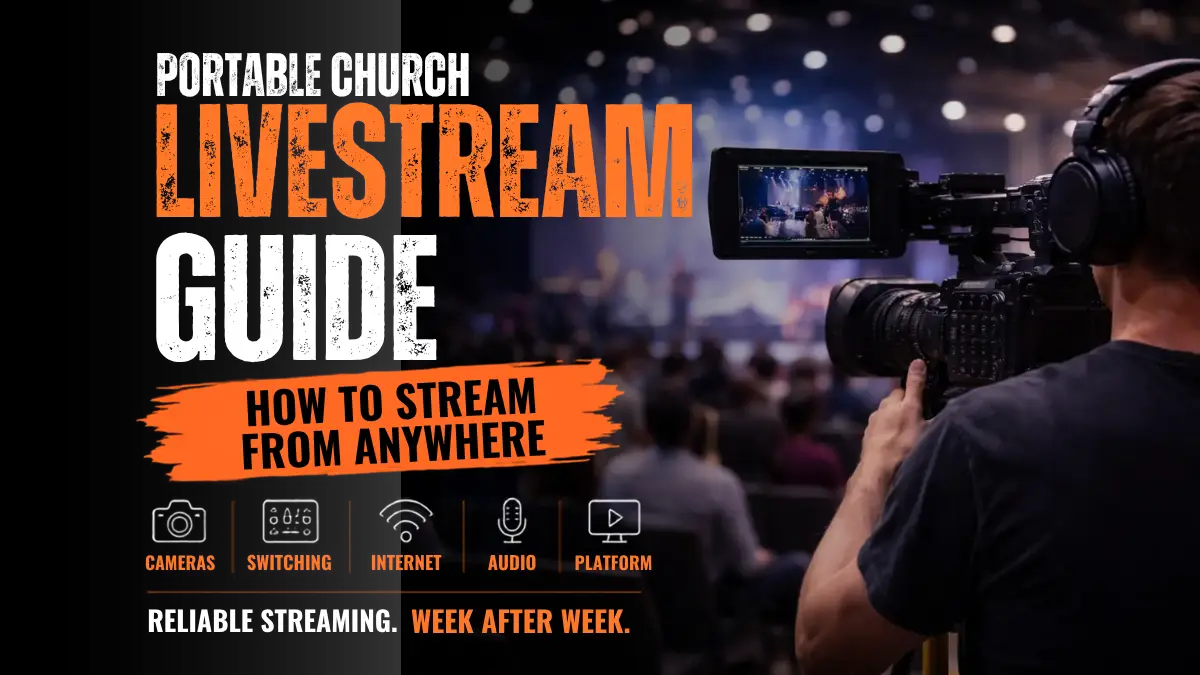
For a more complete look at how lighting and livestream video interact, the Portable Church Livestream Guide covers camera and capture considerations in detail.
Budget Tiers: What a Portable Church Lighting Rig Costs
Equipment only. Stands, cables, cases, and any custom printed materials add to these totals.
Entry-level portable lighting rig ($1,500 to $3,500) Best for: Small congregation, simple stage, getting the basics right
- 4x Chauvet DJ SlimPAR Pro RGBA on T-bar stands for front wash
- 4x Chauvet Freedom Par Hex-4 for wireless backdrop color
- Chauvet DJ Obey controller
- Basic pipe and drape backdrop system
Mid-range portable rig ($5,000 to $10,000) Best for: Growing congregation, contemporary worship style, camera-quality stage
- 6 to 8x professional wash fixtures with high CRI front wash
- 2x Chauvet Intimidator Spot 110 moving heads
- Wireless DMX transmitter and Freedom Par uplights
- Chauvet Obey or entry ChamSys controller
- Tension fabric backdrop system with custom print
Professional portable rig ($12,000 to $22,000) Best for: Larger congregation, full production lighting look, high-quality livestream
- 8 to 12x professional RGBW wash fixtures
- 4x mid-range moving heads
- ChamSys MagicQ MQ50 with full scene programming
- Wireless DMX throughout
- Modular panel backdrop system with uplighting integration
- Haze machine for beam definition
The Consistency Problem (and How to Solve It)
The biggest challenge for portable church lighting is not the gear. It is the fact that each week a different volunteer is responsible for making the stage look the same as it did last Sunday.
Save every lighting scene to your console before your first volunteer-led service and make them password-protected. Give your team a laminated setup diagram that shows exactly where each stand goes, the trim heights, the angles, and which direction each fixture faces. Build a numbered cable kit so there is no guessing about which cable goes where.
A six-fixture rig that is set up and operated consistently every week looks better than a twelve-fixture rig that looks different every Sunday. The process matters as much as the gear.
If your team needs help developing a repeatable setup workflow or training new volunteers on your specific equipment, our hands-on AVL training for church teams can be done on your actual gear in your actual venue.
Want Help Designing Your Portable Lighting Rig?
Every portable church setup is different, and the right lighting design depends on your venue, your stage size, your worship style, and what your livestream camera needs to see. If you would like a lighting spec tailored to your situation rather than a generic gear list, contact Presence Pro Audio and we will put together a recommendation that works for your specific environment.
The Full Series
This post completes our four-part guide to portable church AVL systems.
- The Complete Guide to Portable Church AVL Systems — Hub overview
- Portable Church Sound System Guide — Audio equipment and setup
- Portable Church Livestream Guide — Cameras, switchers, and streaming
- Portable Church Lighting and Stage Design Guide — You are here
Presence Pro Audio designs, installs, and supports audio, video, and lighting systems for churches and venues in Alabama, Tennessee, and Indiana.